
Arrests.org HI – Hawaii Public Arrest, Inmate & Mugshot Records
Arrests.org HI serves as a third-party search tool that many people use to view mugshots and jail data, but relying solely on this site leaves gaps in your research. Official government databases managed by the State of Hawaii provide the most accurate and current files. You need valid data when checking a person’s background for legal, employment, or personal safety reasons. Third-party sites often list old or removed charges. State-run systems update their files daily. This page explains how to get accurate records directly from the Hawaii Criminal Justice Data Center, the Judiciary, and county police departments.
Hawaii laws allow you to view most government documents. The Uniform Information Practices Act (UIPA) makes sure agencies share files with the public. You do not need special permission to see arrest logs, court cases, or inmate locations. You can view these files online or visit government offices in person. Knowing which office holds the specific file you need saves time and money. Police departments hold arrest reports. The courts hold trial records. The Department of Public Safety manages prisons. Each agency has its own rules and fees.
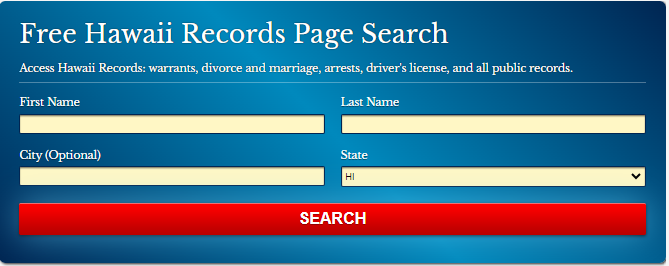
Public Record Sources vs. Third-Party Sites
Arrests.org HI, and similar commercial sites, collect data from many places and put it on one screen. This helps when you do not know where a person was arrested. These sites scan county sheriff pages and state databases automatically. The problem is that the scanning process can miss updates. A judge might dismiss a case today, but the third-party site might show the charge for months. This causes problems if you use that data to make decisions about a person.
Official state repositories are the original source of the data. When a police officer types a report, it goes into the department’s local system. When a judge makes a ruling, the court clerk enters it into the state judiciary system. These are the primary records. If there is a mistake here, it is a legal error. If there is a mistake on a private site, it is just bad data. Always check the official source to confirm what you see on other websites.
The Hawaii Criminal Justice Data Center (HCJDC)
The Hawaii Criminal Justice Data Center (HCJDC) manages the central database for all criminal history in the state. Police from Honolulu, Maui, Kauai, and Hawaii County send their arrest data here. The courts send conviction data here. This is the most complete list of criminal history in Hawaii. Employers, landlords, and licensing boards use this data for official background checks.
You can request a review of your own record or someone else’s record through the HCJDC. They offer both name-based searches and fingerprint-based searches. A fingerprint search is more accurate because names can be the same. A name-based search is faster and cheaper. You can do these searches online or by mail.
Hawaii Arrest Lookup Procedures
A Hawaii arrest lookup starts at the county level for recent events. Police departments keep logs of everyone they book into jail. These logs show the name, the time of booking, and the specific charges. This data is fresh. It often appears within 24 hours of the event. The HCJDC database might take a few days or weeks to show a new arrest. If you need to know if someone was caught last night, check the local police department first.
Hawaii has four main police departments. Each one covers a specific island or group of islands. There is no statewide sheriff’s department that patrols streets. The Sheriff Division in Hawaii mostly handles court security and prisoner transport. The county police departments handle 911 calls and investigations. You must contact the correct department to find a report.
Honolulu Police Department Records
The Honolulu Police Department (HPD) serves the entire island of Oahu. This is where most of the state’s population lives. HPD processes a large number of arrests daily. They have a Records and Identification Division where you can ask for reports. You can visit their main station on South Beretania Street. They charge a small fee per page for copies of reports.
HPD also posts a daily arrest log in some public areas or provides it to the media. This log lists the adults charged with crimes. It does not always list people who were released without charges. If you need a specific report for insurance or court, you must fill out a specific request form. Bring a valid photo ID and cash or a money order to pay for the copies.
Hawaii County (Big Island) Police Records
The Hawaii Police Department covers the Big Island. They have stations in Hilo and Kona. The procedure is similar to Honolulu. You go to the records section and ask for the file. The Big Island is large, so make sure you contact the station closest to where the incident happened. Reports might take time to move from a district station to the main headquarters.
Maui and Kauai Police Records
Maui Police Department covers Maui, Molokai, and Lanai. The Kauai Police Department covers Kauai. Both agencies have records divisions open to the public during business hours. Call ahead to check their specific hours and copy fees. They might require you to mail in a request form if you cannot go in person. Always have the case number ready if you know it. This speeds up the search significantly.
Using the eCrim System for Criminal History
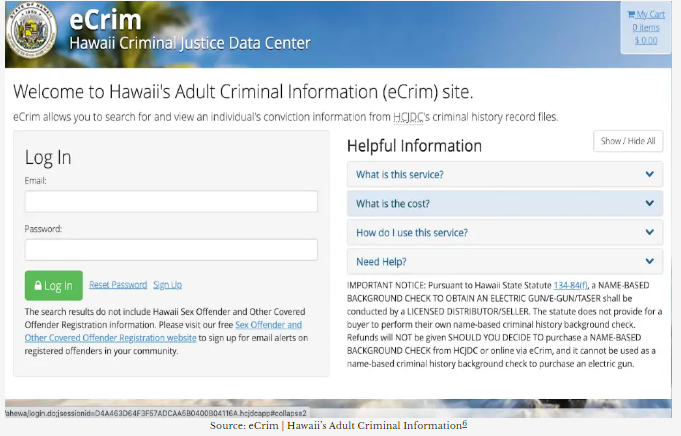
The state created the “eCrim” website to let people view conviction data from home. This system connects directly to the HCJDC database. It is a paid service, but the cost is low. You create an account with an email address. Then you enter the person’s name and other details like date of birth or social security number.
Cost and Search Results
Each search on eCrim costs $5.00. If the system finds a record, you can pay an additional $10.00 to print a formatted report. This report shows convictions. It usually does not show arrests that did not result in a conviction. This is a key difference between eCrim and a full police background check. eCrim focuses on what the court proved, not just what the police suspected.
The report you get from eCrim is not a certified document. It is for your personal knowledge. If you need a certified copy for a visa or a job application, you must ask the HCJDC office directly. They put an official seal on the paper. The online version is good for landlords or neighbors who want a quick check.
Steps to Use eCrim
- Go to the official eCrim website (ecrim.ehawaii.gov).
- Click “New User” to make an account.
- Log in and select “Search.”
- Type the Last Name and First Name. Adding a birth date helps narrow the list.
- Review the list of names that match.
- Click on the correct name to see the list of cases.
- Pay the fee with a credit card to view the details.
Hawaii Inmate Locator and Jail Lists
Finding someone in custody requires a different set of tools. When police arrest someone, they take them to a police cellblock or a community correctional center. Hawaii has a unified system. The Department of Public Safety runs both the jails (for people awaiting trial) and the prisons (for sentenced felons). This makes searching easier because one system covers most facilities.
SAVIN and VINE Systems
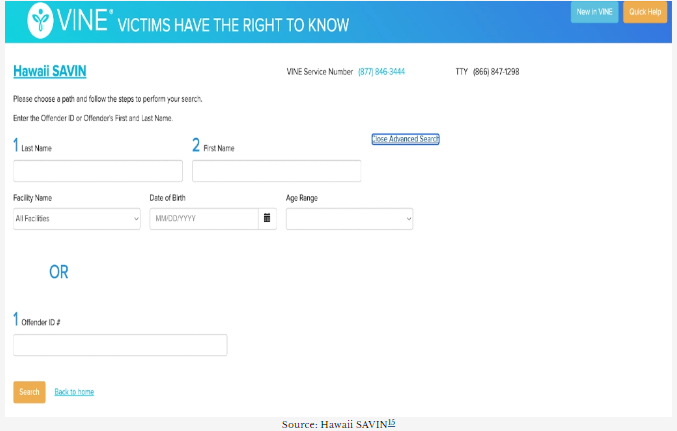
Hawaii uses a system called SAVIN (Statewide Automated Victim Information and Notification). This connects to the VINE network. This tool is free. You can search for inmates online or by phone. It updates frequently. When you search for a name, it tells you which facility holds the person. It also lists their custody status.
You can sign up for alerts on SAVIN. If the inmate moves to a new jail or gets released, the system sends you a text or email. This is helpful for victims who want to stay safe. It is also useful for family members who want to know when to pick someone up. You do not need to be a victim to use this site. It is open to everyone.
Federal Prisoners in Hawaii
Some people face federal charges. The Federal Bureau of Prisons (BOP) holds these inmates. The state SAVIN system does not list federal prisoners. You must use the BOP inmate locator on their website. The Federal Detention Center (FDC) in Honolulu holds most federal defendants. The BOP site lets you search by name or by registration number. It shows the release date or the location of the prison.
Hawaii Mugshot Search and Privacy Laws
A mugshot is the photo taken during booking. In Hawaii, these photos are government records. The public can see them. However, the state does not have a single “mugshot gallery” website. Police departments do not usually post every photo online to protect the privacy of people who might be innocent. You usually have to go to the station or look at specific press releases to see them.
Third-party sites like Arrests.org HI scrape these photos from wherever they can find them. They create the galleries that people search for. Be careful with these images. A person might look guilty in a photo, but the court might have dropped the charges later. The photo stays on the internet long after the case ends. Hawaii law allows these sites to exist, but new rules in many states are starting to limit how companies can use these photos for profit.
Removing Mugshots
If your photo appears on a private site, removing it is hard. You can ask the site owner to take it down. Some will do it for free if you show proof that the case was dismissed. Others might ignore you. Never pay a site to remove a photo without talking to a lawyer. Paying often encourages them to post it on other sites they own. The best way to clear your name is to get the official record expunged.
Hawaii Court Records and Case Search
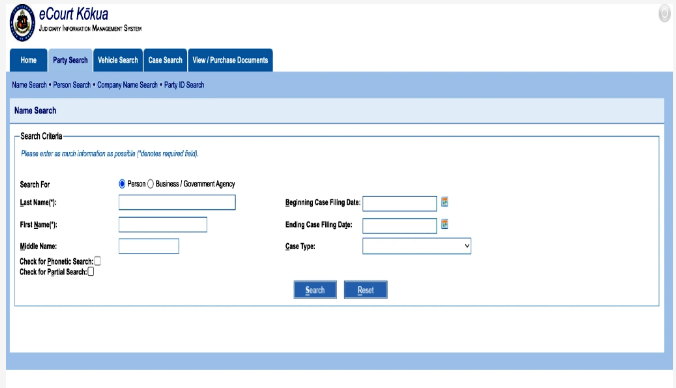
The Hawaii State Judiciary keeps files on every court case. This includes criminal trials, traffic tickets, and civil lawsuits. The system they use is called “eCourt Kokua.” This is a powerful search engine for legal documents. It connects all the courts in the islands. You can see what happened in a courtroom in Hilo even if you are in Honolulu.
Using eCourt Kokua
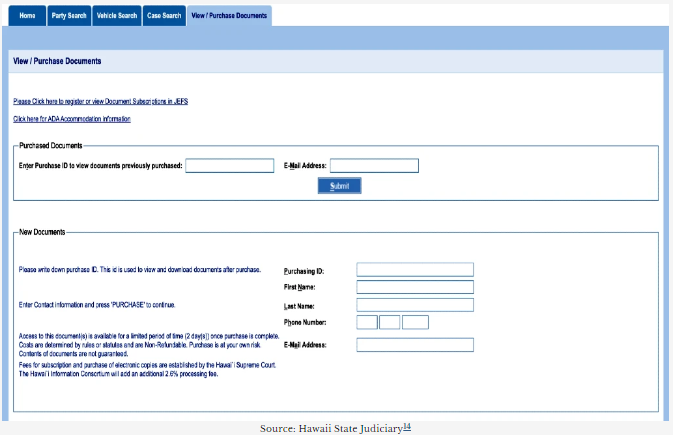
eCourt Kokua has a free version and a paid version. The free version lets you see basic case information. You can see the charges, the hearing dates, and the judge’s name. You can search by the defendant’s name or the case ID. This is enough for most background checks.
The paid subscription is for lawyers or people who need to download many documents. It costs a flat fee for a specific time period. With a subscription, you can open the PDF files of motions and orders filed in the case. If you do not want to pay, you can visit a courthouse. Each courthouse has public computers. You can view the full documents on these computers for free. Printing costs 10 cents per page.
Traffic and Civil Records
eCourt Kokua also lists traffic infractions. Speeding tickets and parking violations appear here. These are civil violations, not crimes, but they stay on the record. Landlords also check this system to see if a tenant has eviction cases. These are called “Summary Possession” cases. Seeing an eviction record helps landlords decide who to rent to.
Hawaii Sex Offender Registry
The state maintains a public list of people convicted of sex crimes. This is a safety tool for families. The Hawaii Criminal Justice Data Center manages this registry. You can search it online for free. The site lets you look up names or search by location. You can type in your address and see if any offenders live nearby.
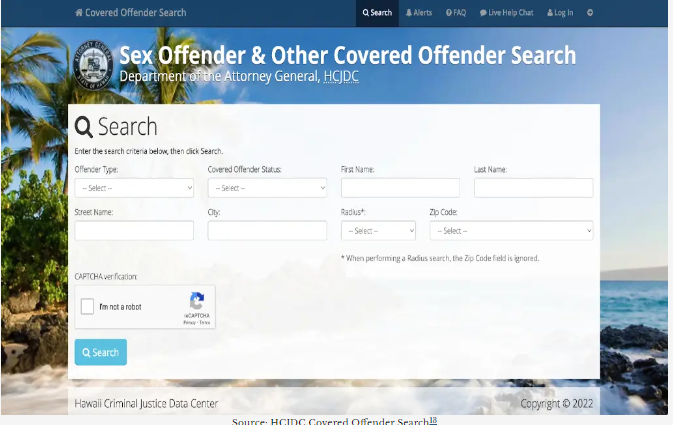
The registry classifies offenders by tiers. Tier 1 is the lowest risk. Tier 3 is the highest risk. The website shows the person’s photo, address, and the crime they committed. It also lists the vehicle they drive. Strict laws tell offenders where they can live and work. If they break these rules, police can arrest them again.
Mobile App for Registry
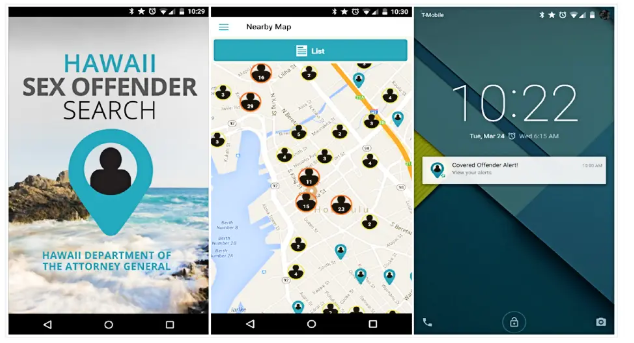
The state also has a mobile app for the sex offender registry. You can download it on your phone. It uses your GPS to show offenders on a map around you. This is useful when moving to a new neighborhood or choosing a park for your children. The app updates regularly with data from the Attorney General’s office.
Background Checks and Employment Laws
Employers in Hawaii must follow strict rules when checking criminal records. Hawaii was one of the first states to pass a “Ban the Box” law. This law stops employers from asking about criminal history on the initial job application. They can only ask about it after they make a conditional job offer. This gives people with a record a fair chance to show their skills first.
Employers can only consider convictions that relate to the job. For example, a bank can refuse to hire a person convicted of theft. A construction company might not care about a theft conviction from ten years ago. Employers cannot use arrest records that did not lead to a conviction. If the court dismissed the case, the employer must ignore it.
Fair Credit Reporting Act (FCRA)
Federal law also protects you. The Fair Credit Reporting Act (FCRA) sets rules for professional background check companies. If an employer uses a company to run a check, they must get your written permission. If they decide not to hire you because of the report, they must give you a copy. You have a right to fix any mistakes in the report before they make the final decision.
Expungement of Records
A criminal record can hurt your chances for jobs and housing. Hawaii allows you to expunge (erase) arrest records if the state did not convict you. If the police arrested you but released you without charges, or if the court found you not guilty, you can apply for expungement. You must fill out a form with the Attorney General’s office.
Expungement is not automatic. You must ask for it. There is a fee for the process. Once the state expunges the record, they remove it from the public files. You can legally say you were never arrested for that crime. However, you cannot expunge valid convictions. Those stay on your record unless you get a pardon from the Governor, which is rare.
Vital Records: Birth, Death, and Marriage
Sometimes a background check requires more than just criminal data. You might need to prove identity or family status. The Department of Health manages vital records in Hawaii. These include birth certificates, marriage licenses, and death certificates. These are not open public records like court cases. Only people with a “direct and tangible interest” can get them.
You can order these records online through the eHawaii portal. You will need to upload a copy of your ID to prove who you are. The fee is around $10 to $12 for the first copy. You can also visit the Department of Health building in Honolulu. The lines can be long, so ordering online is usually faster.
Marriage and Divorce Records
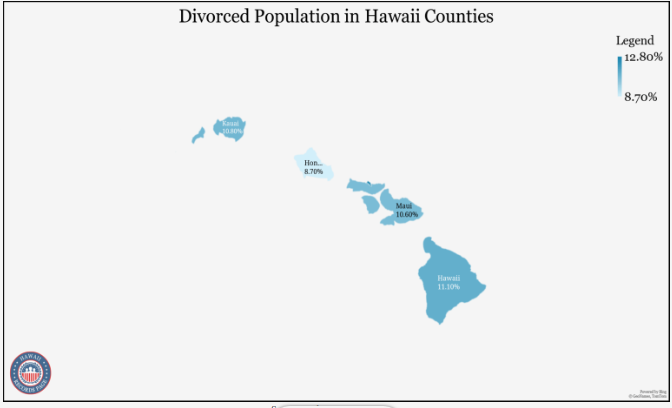
Marriage certificates come from the Department of Health. Divorce decrees come from the Family Court. If you need to check if someone is really divorced, you use the eCourt Kokua system to find the divorce case number. Then you can ask the court clerk for a copy of the decree. The decree shows the date the marriage legally ended.
Hawaii County Police and Sheriff Contact Data
Direct contact with law enforcement is often the fastest way to get information. Below is a list of the main police departments and their contact details. Always call the non-emergency line for records. Never call 911 for record requests.
| Agency Name | Address | Phone Number | Service Area |
|---|---|---|---|
| Hawaii Criminal Justice Data Center | 465 S. King St, Rm 102, Honolulu, HI 96813 | (808) 587-3279 | Statewide (Criminal History) |
| Honolulu Police Department | 801 South Beretania St, Honolulu, HI 96813 | (808) 529-3191 | Oahu |
| Hawaii Police Department (Hilo) | 349 Kapiolani St, Hilo, HI 96720 | (808) 961-2233 | Big Island (East) |
| Kona Police Station | 74-5221 Queen Kaahumanu Hwy, Kailua-Kona, HI 96740 | (808) 326-4646 | Big Island (West) |
| Maui Police Department | 55 Mahalani St, Wailuku, HI 96793 | (808) 244-6345 | Maui County |
| Kauai Police Department | 3990 Kaana St, Lihue, HI 96766 | (808) 241-1661 | Kauai County |
Frequently Asked Questions
This section answers common queries related to Arrests.org HI and how arrest information is displayed for Hawaii. It explains the source of the data, the site’s status, and how it differs from official state platforms. The purpose is to help readers know what the website shows, how reliable the listings are, and where to verify records through approved Hawaii government systems.
Is Arrests.org HI a government website?
No, Arrests.org HI is a privately owned website. It is not affiliated with the State of Hawaii, the police, or the courts. It collects public data from government sources and displays it. Because it is not official, the data might be out of date or incorrect. For official records, you must use state-run sites like eCrim or eCourt Kokua. Government sites provide the legal version of the file that courts and employers recognize.
How much does it cost to look up someone’s criminal record in Hawaii?
The cost depends on the method you use. Searching for active court cases on eCourt Kokua is free if you only view the basic summary. Searching for detailed conviction history on the eCrim website costs $5.00 per search. If you want a printed report from eCrim, it costs an extra $10.00. Searching for inmates using the SAVIN system is completely free. Visiting a police station to get a copy of an arrest log usually costs a small fee per page, often around 25 to 50 cents.
Can I see if someone has a warrant in Hawaii online?
Yes, you can check for warrants using the eBench Warrant system provided by the Hawaii Judiciary. This is a free online tool. It lists active bench warrants that judges have issued. These are usually for people who failed to appear in court. Not all arrest warrants appear here. Some police warrants for new crimes might not be public yet to protect the investigation. If you think you have a warrant, contacting a lawyer is the safest step.
What is the difference between an arrest record and a conviction record?
An arrest record simply means the police took a person into custody. It does not mean the person is guilty. The police might release them, or the prosecutor might drop the charges. A conviction record means a court found the person guilty of a crime. Employers in Hawaii can usually only consider conviction records. They cannot use arrest records that did not lead to a conviction to deny someone a job.
How do I visit an inmate in a Hawaii jail?
To visit an inmate, you must be on their approved visitor list. You need to fill out an application form and send it to the facility. The security staff will check your background. Once approved, you can visit during specific hours. You must bring a valid photo ID. Dress codes are strict. You cannot wear revealing clothes or clothes that look like inmate uniforms. You cannot bring cell phones or gifts into the visitation room.
Are juvenile records public in Hawaii?
No, juvenile records are confidential. The law protects the privacy of minors. The public cannot search for records of people under 18. Only the minor, their parents, their lawyers, and court officials can see these files. In very rare cases involving serious felonies, a judge might allow some information to be released, but this is not common. Once the person turns 21, they can often ask to have these records expunged.
How far back do Hawaii background checks go?
Hawaii’s criminal history records go back decades. The HCJDC database holds files from the 1970s and earlier. However, the “Ban the Box” law limits how far back an employer can look for certain types of decisions. Generally, felonies stay on the record indefinitely unless expunged. Misdemeanors also stay on the record. Most standard background checks will show the person’s entire adult history in the state.